Thursday, March 6, 2014

Saturday, March 30, 2013
The Lord Is Risen In Deed.
Easter
Exodus 14:10-31; 15:20-21 [Israel's deliverance at the Red Sea]
Ezekiel 37:1-14 [The valley of dry bones]
At The Eucharist
Romans 6:3-11
Psalm 114
Luke 24:1-12
Today I'm going to write about my father's resurrection. I expect that everyone who's been reading this blog over these last several weeks (all four of you) knows that my dad died about a year and a half ago. He did not want to die. At one point in his life, he really believed humans would find a way to cheat death so that we could live virtually forever. He once told me that he was jealous of me because he knew that for him it was too late, but that I would probably live to see those days. I didn't have the heart to tell him that I wasn't sure I'd want to take advantage of eternal mortal life.
Our was a cordial but rather distant relationship in adulthood. I had come to learn and accept that the type of relationship I wanted to have with him was not a relationship he was capable of having with me. I think he had to come to similar acceptances about me. There were many times that I kept in contact or initiated a visit specifically because I didn't want to regret my behavior after he died.
Yet when he died, I was devastated and full of regret. I questioned every interaction I had with him. I examined our time together like a dumped teenager--what did he mean when he said this? If I had done that, would things have been different? Was I fair to him? Was I faithful? Was I good?
So I know--I think most of us know--why Peter took off and ran to the tomb as soon as the women said that Jesus had been raised from the dead. Because if Jesus was, like Miracle Max says in The Princess Bride, "only mostly dead," Peter wanted his chance to say all those things he should have said, and he didn't care who laughed at him for believing what his friends called an idle tale.
But I was going to talk about my father's resurrection. My father was an atheist, so by most understandings of Christianity, Heaven was not really a comfort to me when I considered Dad's death. Thank God nobody told me in the funeral that he was in a better place, because I'm sure I would have burst into tears. I'm not even sure Dad would be happy in Heaven, being expected to serve a God he never knew, or at least, never recognized as a friend. So, clearly, heaven and eternal life are not the resurrection I'm thinking about when I write that Dad has been resurrected from the dead.
His resurrection has happened inside of me. Not at first, because at first I was too ripped apart by grief and confusion for him to be anything but dead. His death was a presence in my life.
But a few months ago, things began to change. One morning I realized that Dad had begun to occupy a different place in my brain. A place where things didn't really hurt--they just were. Somehow Dad became a different kind of alive in my imagination and memory. Things that he had said to me or done with me took on new and different meanings as they percolated through all of my memories. And as I continued to live, my life experiences informed my memories, and helped me to understand things in new ways. I ran with my fifth-grader in a 5K, just like Dad had done with me, and I found myself handing down some of the same advice he's given me. My Dad continues to influence me and advise me because he lives again, resurrected and re-resurrected in my mind, and in my stories that I tell my own children about him. In some ways, I grow closer to him as I live into the fullness of his life--as my children grow older and I go through what he went through with me, I know him better as I walk in a version of his shoes.
I don't want to water down the great hope we have in Easter by saying that my father's resurrection is Jesus' resurrection--that we make Jesus live again by telling his story and letting his words enlighten and inform us, and by letting the example of his life be a shining beacon to us when the darkness of the world seems like all there is.
But certainly, we, the Body of Christ, are part of what keeps his heart thumping. When we participate in the eucharist, or allow Jesus' teachings to inform our behavior and open our hearts, we are participants in Jesus' resurrection. When we give hope to the hopeless, homes to the homeless, food to the hungry, and a compassionate ear to those who are troubled, we are re-resurrecting Christ. Every time we choose to live, as much as we can, the way Jesus lovingly, desperately wanted us to live, that is when we are, as Paul said, baptized into his resurrection.
As Christ's body, we are all, always, being asked to do and believe in the impossible. Moses lead his people away, safely, from his oppressors. Ezekiel turned corpses into an army with a few commands. We are able to hold our hearts open to the people who need us and the people we need, even after those hearts have been damaged by the very people we're opening them to. And we are asked to live hopefully even when hope is so thin and spare that it seems like it would just be safer to close ourselves off to the possibility of hope--to dismiss rumors of the miraculous cynically as idle tales.
So, lent is over now. Easter is here. Jesus is alive. He was only ever mostly dead, and now there is a great deal to do. Let's go do it. Because the Lord is risen. He is risen in deed.
Saturday, March 23, 2013
Reclaiming the Passion
The Liturgy of the PalmsLuke 19:28-40
Psalm 118:1-2, 19-29
The Liturgy of the Word
Isaiah 50:4-9a
Psalm 31:9-16
Philippians 2:5-11
Luke 22:14-23:56 or Luke 23:1-49
Remember way back on the first Sunday in Lent, I wrote this post about how God lets really horrible things happen to people all the time? And I mentioned that I didn't think a loving God would devise a plan that ripped children from the arms of their mothers, or forced parents to watch their children die. I still don't think that. Which makes a lot of our doctrine about the crucifixion a little problematic, to say the least.
Christianity has traditionally understood the cross as the way to salvation for sinners. If you spent any time in fundamentalist circles during your life, then you've seen the diagram where human sinners are on one side of a deep chasm, God is on the other side, and the cross is suspended like a bridge in between. Usually there are Bible verses printed for each part of the story, and these pages were printed up in pocket sized tracts so that you could always have one handy if you needed to share the gospel.
Here's a good example:
We're so used to thinking about the crucifixtion as the place where the cosmic deal went down--often preachers and teachers will focus a great deal on the suffering that Jesus had to endure in order to pay the price for our sins, and they even encourage us to think about how our sins are hammering the nails into Jesus' hand and feet.
But what if Jesus' suffering wasn't necessary? What if the crucifixion was never part of the plan? I said before that I didn't think God was the kind of douchebag God who would purposely force a mother to watch her child die in her arms, and I don't think his own son is any exception. You can tell from Jesus' behavior in the gospel lesson that he's a little wigged out. He's repeating himself about the bread and wine. He tells his disciples to get some swords and money even though he's never placed any value on such things before. I mean, let's be honest, he's acting a little bit drunk and a whole lot crazy.
And I think he's acting crazy because he's engaged in a mighty struggle. Is he going to be the Messiah that was part of the plan--the one who speaks truth to power and hangs with the powerless? Is he willing to die for that vision? Or are the people throwing the palm fronds the ones who are right? Maybe the Messiah needs to be a military ruler who gathers the chosen people together to rise up against the powerful oppressors and usher in the kingdom of God by force? It certainly seems like he's toying with that possibility in Luke's gospel.
You want to talk about torture? What do you suppose it's like to throw your whole self into a new and radical vision for the world, one that includes people who were formerly excluded, one that knocks everything everyone knows about power and worthiness on its end, and then, when you know people are coming to kill you, to suddenly see that you may have gotten it all wrong? That you've given your whole life to a vision that's going to come to nothing. That you've failed the universe. In that state, I'm not sure he'd even notice when the nails went in.
But then, he goes to Gethsemane, and something happens there. Jesus reclaims his true vision. He lets go of orchestrating own survival and gives himself back over to the big picture. He surrenders himself and says, "Not my will, but yours be done." As far as I'm concerned, this is the turning point of the story. Everything else is denoument.
Because despite what's been implied from pulpits and Sunday school flyers and televangelists' broadcasts for generations, Jesus was not born to die. Jesus was born to live, and to live so purely and abundantly that we who could ignore the world's distractions would see in his life a way to find real lives of our own. Lives of connection and inclusion and compassion. Lives of reclaiming a vision of what our lives are really for.
In my very first post introducing this blog, I rather flippantly said that Lent was all about guilt. I was wrong. Lent is about reunion, revision and recommitment. Lent is meant to be our time in the garden of Gethsemane, which gives us the vision to do what we are meant to do, regardless of how much of a beating we take for it. Because this part of the Good News is called the passion for a reason.
Psalm 118:1-2, 19-29
The Liturgy of the Word
Isaiah 50:4-9a
Psalm 31:9-16
Philippians 2:5-11
Luke 22:14-23:56 or Luke 23:1-49
Remember way back on the first Sunday in Lent, I wrote this post about how God lets really horrible things happen to people all the time? And I mentioned that I didn't think a loving God would devise a plan that ripped children from the arms of their mothers, or forced parents to watch their children die. I still don't think that. Which makes a lot of our doctrine about the crucifixion a little problematic, to say the least.
Christianity has traditionally understood the cross as the way to salvation for sinners. If you spent any time in fundamentalist circles during your life, then you've seen the diagram where human sinners are on one side of a deep chasm, God is on the other side, and the cross is suspended like a bridge in between. Usually there are Bible verses printed for each part of the story, and these pages were printed up in pocket sized tracts so that you could always have one handy if you needed to share the gospel.
Here's a good example:
 |
| Bridge to Life Illustration from Navigators website |
But what if Jesus' suffering wasn't necessary? What if the crucifixion was never part of the plan? I said before that I didn't think God was the kind of douchebag God who would purposely force a mother to watch her child die in her arms, and I don't think his own son is any exception. You can tell from Jesus' behavior in the gospel lesson that he's a little wigged out. He's repeating himself about the bread and wine. He tells his disciples to get some swords and money even though he's never placed any value on such things before. I mean, let's be honest, he's acting a little bit drunk and a whole lot crazy.
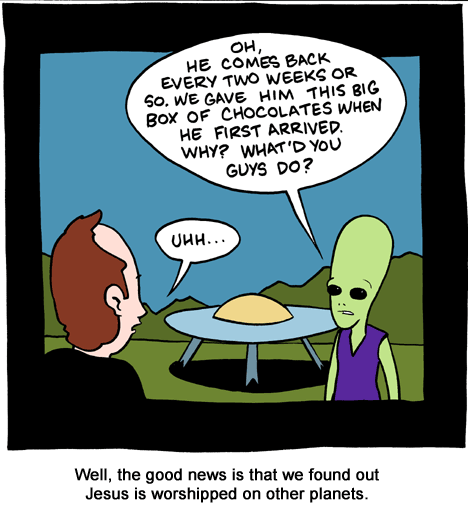 |
| From Saturday Morning Breakfast Cereal |
And I think he's acting crazy because he's engaged in a mighty struggle. Is he going to be the Messiah that was part of the plan--the one who speaks truth to power and hangs with the powerless? Is he willing to die for that vision? Or are the people throwing the palm fronds the ones who are right? Maybe the Messiah needs to be a military ruler who gathers the chosen people together to rise up against the powerful oppressors and usher in the kingdom of God by force? It certainly seems like he's toying with that possibility in Luke's gospel.
You want to talk about torture? What do you suppose it's like to throw your whole self into a new and radical vision for the world, one that includes people who were formerly excluded, one that knocks everything everyone knows about power and worthiness on its end, and then, when you know people are coming to kill you, to suddenly see that you may have gotten it all wrong? That you've given your whole life to a vision that's going to come to nothing. That you've failed the universe. In that state, I'm not sure he'd even notice when the nails went in.
But then, he goes to Gethsemane, and something happens there. Jesus reclaims his true vision. He lets go of orchestrating own survival and gives himself back over to the big picture. He surrenders himself and says, "Not my will, but yours be done." As far as I'm concerned, this is the turning point of the story. Everything else is denoument.
Because despite what's been implied from pulpits and Sunday school flyers and televangelists' broadcasts for generations, Jesus was not born to die. Jesus was born to live, and to live so purely and abundantly that we who could ignore the world's distractions would see in his life a way to find real lives of our own. Lives of connection and inclusion and compassion. Lives of reclaiming a vision of what our lives are really for.
In my very first post introducing this blog, I rather flippantly said that Lent was all about guilt. I was wrong. Lent is about reunion, revision and recommitment. Lent is meant to be our time in the garden of Gethsemane, which gives us the vision to do what we are meant to do, regardless of how much of a beating we take for it. Because this part of the Good News is called the passion for a reason.
Subscribe to:
Posts (Atom)